NASA's Ingenuity helicopter has proven that flight on Mars is possible, but the next generation of Martian rotorcraft aims to push far beyond its predecessor's limits. In a groundbreaking test campaign, engineers at NASA's Jet Propulsion Laboratory (JPL) have successfully demonstrated that next-generation helicopter rotors can operate at supersonic speeds without breaking apart, opening the door for more ambitious aerial exploration of the Red Planet.
Why Supersonic Rotors Matter for Mars
Mars' thin atmosphere—just 1% of Earth's density—poses a unique challenge for rotorcraft. To generate enough lift, rotor blades must spin much faster than they do on Earth. Ingenuity's blades, for example, rotate at about 2,500 rpm, far exceeding a typical terrestrial helicopter. But for future missions carrying larger scientific payloads or even crewed support, even higher speeds are required. Supersonic rotor tip speeds—exceeding Mach 1—could enable heavier vehicles to fly efficiently. However, the risk of shockwaves damaging the blades has long been a concern.
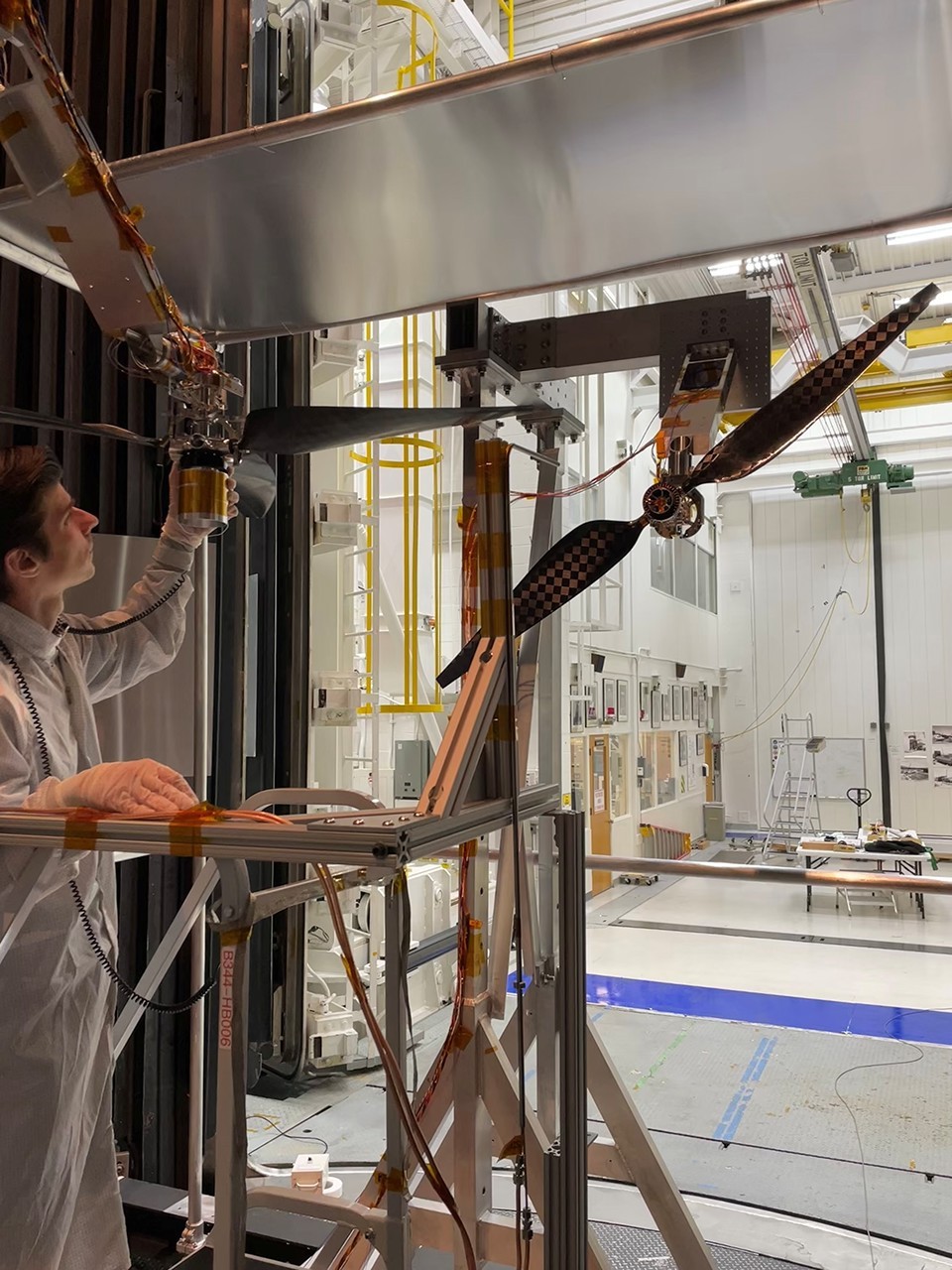
The Test Setup: Simulating Martian Conditions
In November 2025, inside the 25-Foot Space Simulator at JPL in Southern California, engineer Jaakko Karras oversaw the critical test. The chamber mimics the vacuum and low-pressure environment of Mars, allowing rotors to spin under realistic conditions.
Two Rotors, One Objective
The test featured two distinct rotor systems. A horizontally mounted three-bladed next-generation rotor was the main subject. Positioned in the foreground, it was designed to reach supersonic speeds. To create an additional aerodynamic challenge, a vertically aligned two-bladed rotor was placed nearby. This 'headwind' rotor generated a relative air flow, causing the tips of the three-bladed rotor to exceed Mach 1—the speed of sound at Martian surface conditions (about 240 m/s, compared to 340 m/s on Earth).
Monitoring Structural Integrity
Sensors embedded in the blades tracked strain, vibration, and temperature in real time. High-speed cameras captured any visible deformation. The goal was simple but ambitious: prove that a rotor could go supersonic without catastrophic failure.
Results: Surpassing the Sound Barrier Safely
Data from the test campaign brought encouraging news. The next-generation rotor blades not only reached supersonic tip speeds but did so without breaking apart. Shockwaves formed and dissipated as predicted by computational models, and the structural integrity of the composite blades held firm. This marks a significant milestone: for the first time, a Mars rotor has demonstrated the ability to operate in the supersonic regime without self-destructing.

Implications for Future Mars Aircraft
The success of these tests, funded by NASA's Mars Exploration Program, directly supports the development of larger, more capable rotorcraft for future missions. Potential applications include:
- Heavy-lift drones capable of carrying complex scientific instruments across rugged terrain.
- Sample return support by transporting collected material from remote locations to a lander.
- Human exploration aids such as aerial scouts for crewed missions.
The ability to spin rotors faster means that future helicopters can be more compact or lift greater mass—critical trade-offs when every kilogram counts on a Mars mission.
Next Steps: From Test Bed to Flight Hardware
While this test proves the principle, engineers still need to refine blade materials and control systems before a flight-ready design emerges. The next phase will likely involve endurance testing—spinning the rotors for hours to simulate long-duration flights. NASA's JPL, which manages the Mars Exploration Program for the agency's Science Mission Directorate, will continue to lead the effort. A future mission could see a supersonic rotor flying over Mars within the next decade, building on the legacy of Ingenuity.
As exploration pushes into ever-more challenging environments, the ability to generate lift in thin air at extreme speeds will be key. This rotor test brings that future one spin closer.